

Landscapes at second glance
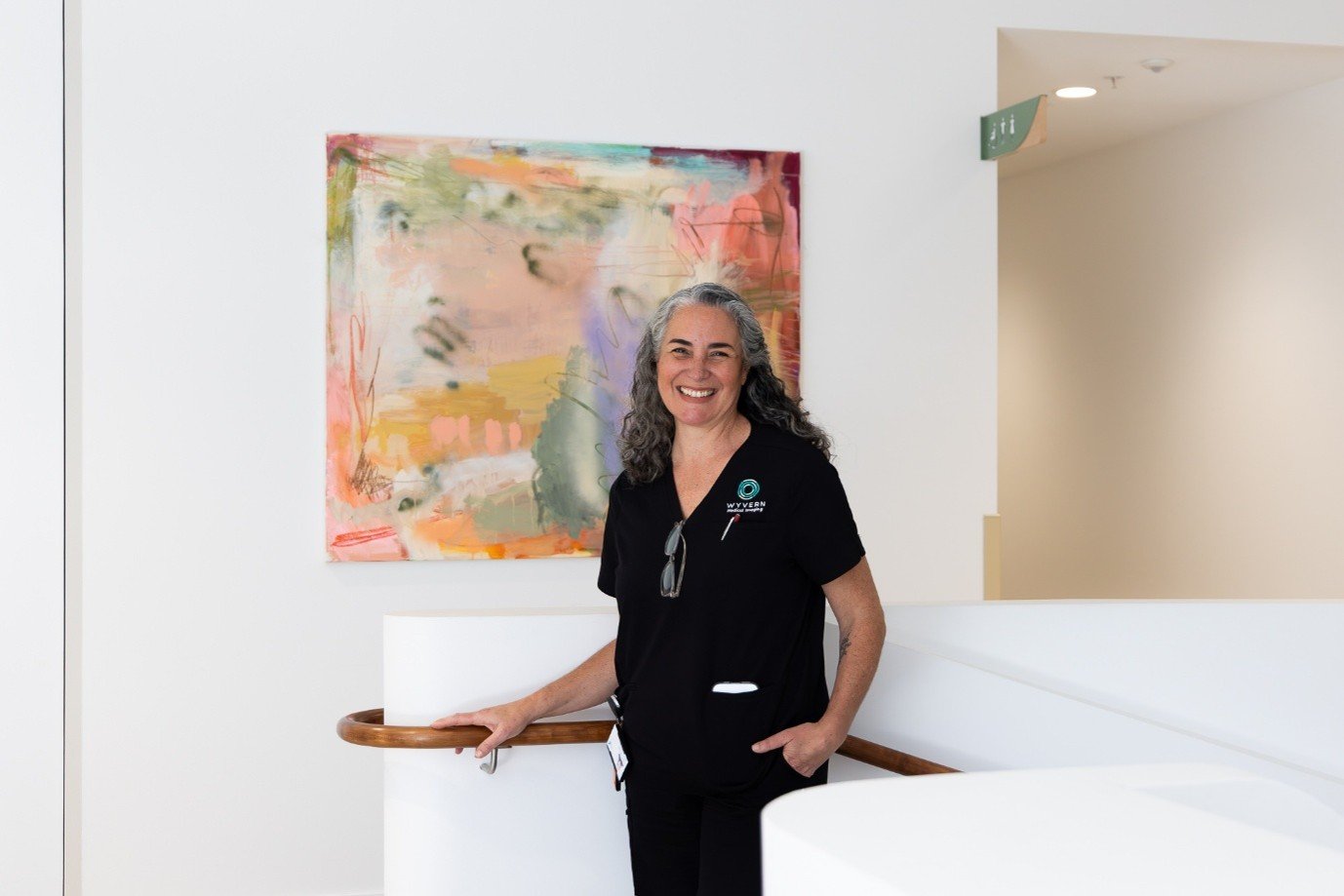
In the imaging department at Wyvern, a painting hangs beside the ultrasound room. At first glance it is a landscape. Look longer and it becomes something else: flowers morph into cells, rivers and ponds into tissues and gradients of grey are assigned colours and layers. It is called Phenomena, and it was painted by the senior sonographer working a few steps away.
Marisabel Gonzalez has been making things for as long as she can remember. As a child in Venezuela, her mother drove her across the city every afternoon for ceramics classes. Her grandmother taught her to sew, and she stitched her own dresses. Later came guitar, then pottery at university. "I've always done something creative, all my life," she says.
The other thread of her life began just as early. She started out studying engineering, then moved to medicine, qualified as a doctor in Venezuela and worked as a general doctor in a health system where resources were scarce and clinical reasoning had to do the heavy lifting. A move to the United States introduced her to ultrasound. Radiology training followed, and then a scholarship in vascular ultrasound brought her to Sydney. She stayed, and has now worked in medical imaging in Australia for 25 years.
It was in the United States that she first picked up a paintbrush. When she arrived in Australia she pursued medicine seriously, intent on practising here. But life in a new country, with a young family, reshaped her plans, and she found herself falling for the work in front of her. "I started seeing the beauty of ultrasound," she says. "I'm happy to still be part of patient care, and to have that other side of my life that I also love." Painting moved from the edge of her life towards the centre. Her early canvases tried to link two homes. "The ocean areas reminded me of some of the beaches in Venezuela. It really isn't similar, but in my head it was."
A residency at a creative space in Freshwater changed everything. She arrived feeling like an imposter among practising artists, not knowing how to build a collection or hang a show. Six months later, on the opening night of the residency exhibition, she sold every painting. "I haven't stopped since."
Ask her what connects the two halves of her working life and the answer comes without hesitation. "For me, painting and medicine are the same practice." Both, she says, are ways of understanding people. And both are built on grey tones. Everything a sonographer reads on screen sits between white and black, in fine gradations that separate the ordinary from the significant. Painters know this territory too. The classical technique of chiaroscuro built entire pictures from a single tonal range, light against shadow. When Marisabel paints, she is often painting the body: ultrasounds, tissues, the forms she knows from the screen. "A lot of people look at them and say, that's a beautiful landscape. But I know it's not."
Her work now hangs throughout the hospital. Phenomena sits with her in the imaging department. A triptych, Field Notes From The Body Of The Earth, hangs at the entrance to the boardroom. A large pink canvas from 2019, A Special Gift, greets people in the lobby, and From The Bottom hangs at reception.
It seems fitting that they hang here. Wyvern's corridors are full of natural light, with windows onto bushland, and Marisabel says it is the first imaging department she has ever worked in with a window.
Ask her what the paintings are really about and she reaches past technique. "Body and nature, for me, are very similar. It's a way of understanding our humanity. How we are all the same. Same energy, same elements."
Some people keep art and science apart. Marisabel never has. Both, for her, begin the same way: looking closely at another human being, and taking the time to understand what you see.